MiTE
Campus
News
Book Launch: “Marka-e-Haq: Deterrence, Provocation, and Strategic Maturity in South Asia”
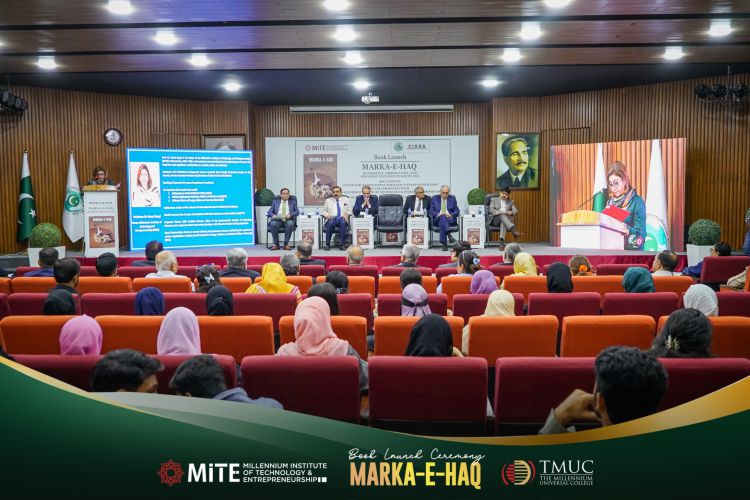
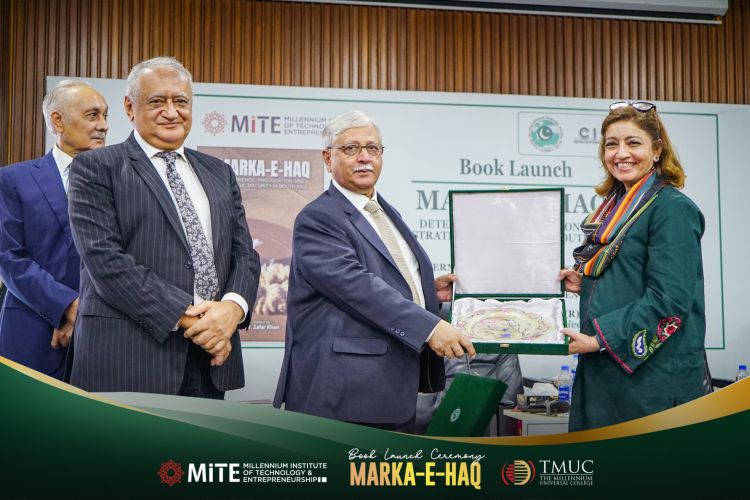
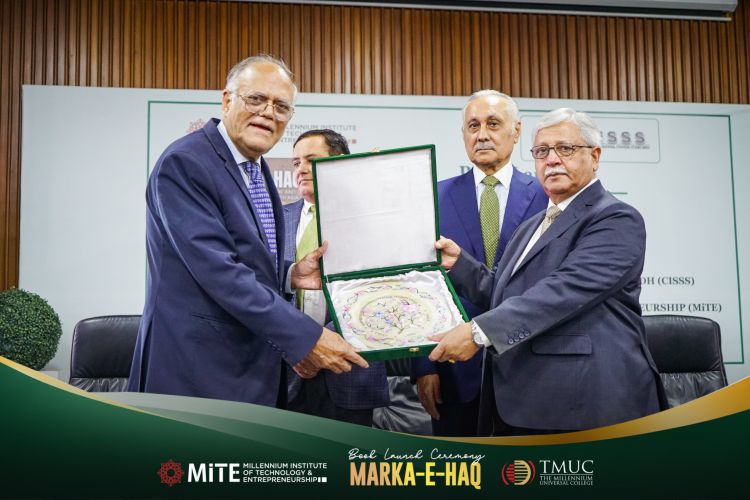
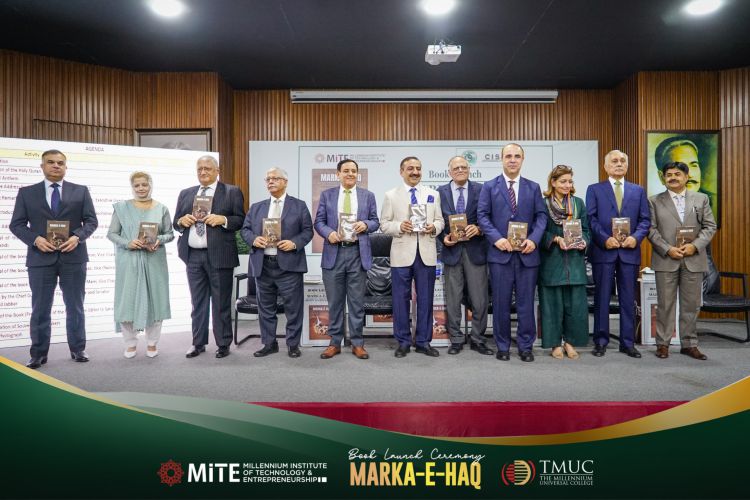
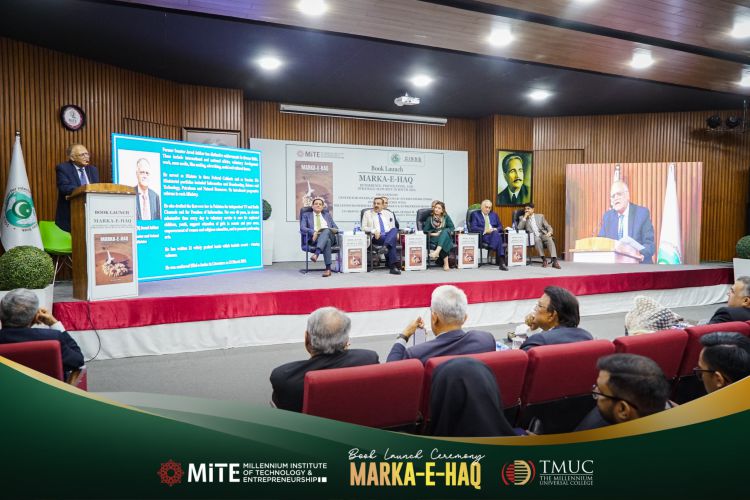
Millennium Institute of Technology & Entrepreneurship (MiTE) and Centre for International Strategic Studies Sindh (CISSS) jointly organized book launch of “Marka-e-Haq: Deterrence, Provocation, and Strategic Maturity in South Asia”. The event was held at MiTE on Thursday, 5 November 2026. Prof. Dr Huma Baqai, Rector MiTE, and Executive Director CISSS Ambassador (R) Qazi Khalilullah were the Co-Hosts.
Former Senator and Federal Minister Mr Javed Jabbar was the Chief Guest. The Keynote Address was delivered by Lt Gen (R) Khalid Ahmed Kidwai, NI, HI, HI (M), Advisor Development National Command Authority. The panel of speakers included Editor of the book Dr Zafar Khan, Executive Director Balochistan Think Tank Network, former Ambassador of Pakistan to Russian Federation and Netherlands Ambassador (R) Mustafa Kamal Kazi, Vice Chancellor of University of Sindh Professor Dr Fateh Muhammad Marri, Vice Chancellor of the University of Mirpurkhas Professor Dr Rafique Ahmed Memon and Vice Chancellor of DHA Suffa University Professor Dr Ahmed Saeed Minhas.
The book Marka-e-Haq is a collection of a distinguished array of voices of senior military leaders, diplomats and scholars who offer multi-dimensional perspectives on the evolving security dynamics of South Asia. The volume presents a tapestry of informed assessments, tracing the arc from conceptual diagnostics to operational lessons and forward-looking recalibrations.
The speakers underscored that the book succinctly captures the pre and post May 2025 Marka-e-Haq developments, troubled history of Pakistan-India relations, Indian machinations against Pakistan, India’s evolving strategic culture and drift, deterrence stability, lessons from recent crises and the future trajectory of strategic stability in South Asia. It also contains details of Indian false flag operations, state-sponsored terror industry supported by Hindutva influenced leadership, human rights abuses in occupied Kashmir and Weaponization of water.
In her welcome remarks, Prof Dr Huma Baqai commended the efforts of the Editor and contributors to the book for bringing together diverse perspectives on the May 2025 Marka-e-Haq. She noted that collectively the authors have woven a rich and realistic tapestry of ideas, insights and analysis. The book is a valuable reference for scholars, policymakers, practitioners, youth, and students of strategic studies and international relations.
In his opening remarks, Ambassador (R) Qazi Khalilullah emphasized that Marka-e-Haq of May last year marked a defining chapter in Pakistan’s history, characterized by resilience, national unity and unwavering resolve. During the 4-Day war initialized by nuclear-armed India against nuclear-armed Pakistan last year, the Armed Forces of Pakistan displayed exemplary courage and professionalism that reinforced the nation’s confidence. Pakistan’s investment in niche technologies developed indigenously served as force multipliers during the war, ensuring failure of Operation Sindoor, which actually turned out to be Operation De-Sindoor as scores of Indian soldiers lost their lives in the war. Pakistan’s Full Spectrum Deterrence ensured that the Indian aggression did not escalate to a full-scale war. Pakistan’s victory in the Marka-e-Haq has enhanced its diplomatic profile, with Islamabad emerging as a peacemaker in the Middle East, a sought-after trustworthy security partner and a source of modern military technology provider to its friends and partners.
While introducing the book, Dr Zafar Khan said that the volume sought to document evolving patterns of coercion, deterrence and crisis behaviour in South Asia. He noted that the book highlights Pakistan’s strategic restraint while examining the risks stemming from India’s unilateral actions, irresponsible nuclear behaviour and disinformation campaign.
Keynote speaker Lt Gen (R) Khalid Ahmed Kidwai highlighted main points of his Chapter contributed to the book, titled “Re-assessing Deterrence Stability in South Asia – Lessons from the May 2025 Crisis”. In the Chapter, he has examined the impact of Indian strategic thought, including nuclear posture, doctrines, and Modi’s so-called new normal on deterrence stability in South Asia. He pointed out that the fundamental dilemma for India has been to reconcile ambition with capability. In this equation, it is evident that Indian ambitions vastly outstrip the Indian political and military capabilities. Politically and strategically, India had set its eyes on becoming a global power in the big league while being a regional hegemon in South Asia. Unfortunately for India, Pakistan’s nuclear weapons and the policy of Full Spectrum Deterrence have largely offset the perceived conventional forces asymmetry of India.
The General highlighted that Prime Minister Modi had talked of the emergence of a “new normal” in South Asia post-Operation Sindoor. “Of course, there is a new normal, except that the new normal is now defined by Pakistan.” These new normals, inter alia, have ensured deterrence stability through a robust combination of Pakistan’s conventional and nuclear forces, and established Pakistan’s air superiority in South Asia. He emphasized that India’s so-called comfort zones of enjoying political, geographical, and economic immunity must be challenged through Pakistan’s long-arm of strategic reach. Talking about the lessons from the May 2025 crisis, he stressed that it is perhaps time to further enhance Pakistan’s conventional forces retaliatory strategy of Quid Pro Quo Plus to Quid Pro Quo Plus Plus. He added that, “when India comes rushing the next time around, the retaliatory punishment should be so severe and unforgiving, directed at the heart of Indian vulnerabilities, which are many, that this dangerous strategy of imposing on Pakistan the BJP’s formula for winning of domestic elections is buried once and for all. Pakistan has had enough of this. India is a target-rich country.”
Ambassador (R) Mustafa Kamal Kazi emphasized that the book Marka-e-Haq documents India’s longstanding challenge to Pakistan’s security and sovereignty. He highlighted Pakistan’s credible deterrence, operational resolve and military professionalism during the May 2025 Four-Day War. Reflecting on India’s democratic backsliding and limited economic and technological progress, he questioned India’s claim to global power status under the ideological imperatives of Hindutva.
Prof. Dr Rafique Ahmed Memon agreed that Kashmir and weaponization of water by India are two nuclear flashpoints in South Asia. Talking about Indian terror industry, he stressed that involvement of Indian state agents in acts of terrorism in Pakistan, Canada and the US is appalling and threatens regional and international peace and security. He added that, in response to India’s provocative and escalatory Operation Sindoor, Pakistan delivered a counterpunch that shifted the conventional balance of military power in South Asia in a span of four days.
Prof. Dr Ahmed Saeed Minhas mentioned that the book is a response to the known fragile security equilibrium in South Asia due to India’s aggressive military and strategic posture. It explores how coercive provocations are manipulatively generated, how deterrence is sustained under intense regional crises; such as during the Balakot crisis of February 2019 and Marka-e-Haq of May 2025; and why strategic restraint and credible deterrence remain essential to preventing crisis escalation across ambiguous thresholds. He underscored that Pakistan’s resilience is unlimited but its strategic restraint is not.
Prof. Dr Fateh Muhammad Marri appreciated the contents of the book, paid compliments to the authors and appreciated the contribution the book has made to the discourse on South Asian strategic stability, deterrence and security. He highlighted how India’s hegemonic designs had alienated its neighbours, contributed to the paralysis of SAARC and raised concerns over the suspension of Indus Waters Treaty. New Delhi’s hostile policies under the Modi government, he said, have isolated India in the region and beyond.
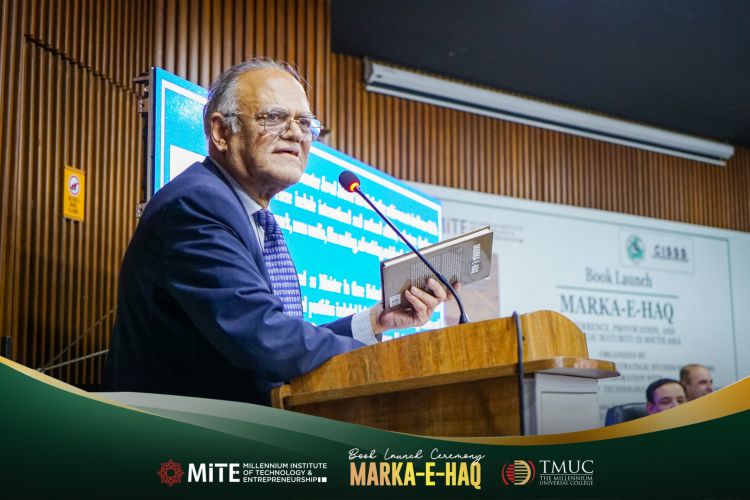
Chief Guest Mr Javed Jabbar lauded strategic vision of national leadership and stellar performance of Pakistan’s armed forces which had been quietly preparing for a possible war with India without chest thumping and surprised India, international community and people of Pakistan with a decisive counterpunch in the Marka-e-Haq. It ensured Pakistan’s victory and India’s defeat in the 4-Day war last year. He emphasized that the significance of the book goes beyond India and Pakistan. Its contents and message deserve to be put on the global map. The book should therefore be translated into other principal languages of the world. He noted that Pakistan, with a population of about 250 million, had the will and the capability to challenge India which has six times larger population and much larger military force and economy.
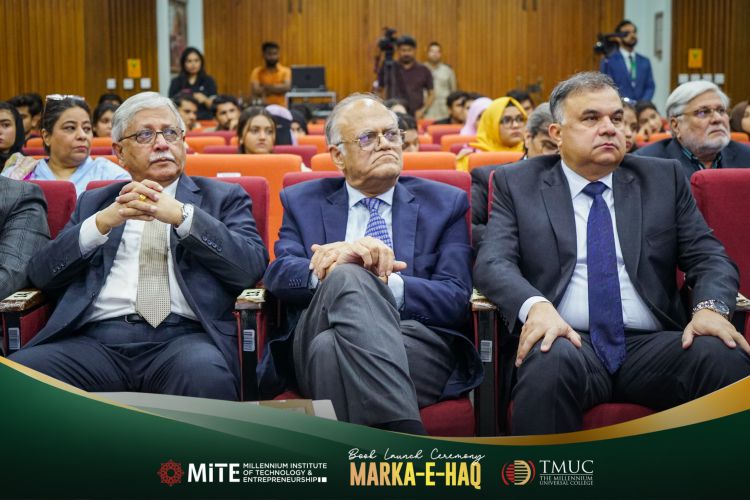
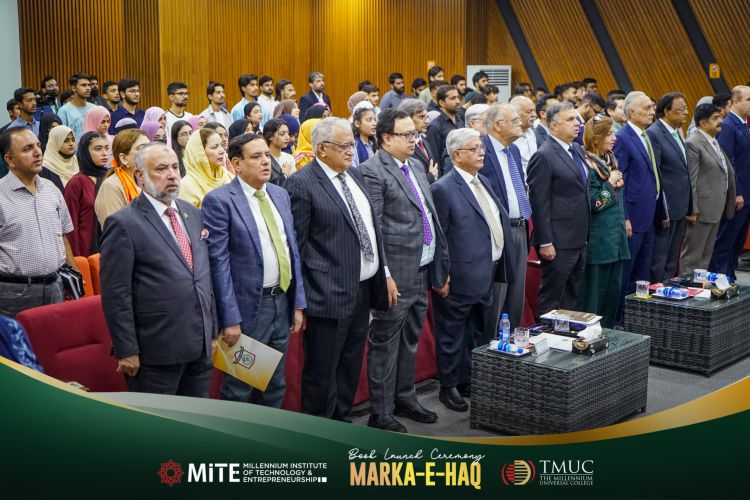
The book launch event was attended by more than 200 guests, including academics, former senior military officers, foreign diplomats, policy analysts, students and media representatives.